
The artistic power of selective attention

None of us see the world in exactly the same way.
When my dad was in an assisted living facility, my siblings and I would have zoom calls with him to check in and check up. Often, my sister and I would have a debrief phone call afterward to compare our impressions of how he was doing. What struck me was how differently we saw him. I’d notice his bright eyes, pink cheeks and cheery smile and tell her that I thought he looked great! My sister would notice his uncombed hair, stubbled face, and oft-repeated sweater and worry that he wasn’t caring for himself.
Put together, our impressions would contain a fuller picture of Dad. Separately, we were focusing on the aspects of Dad that mattered most to our individual brains.
In every aspect of life, I think we miss at least half the picture and, in art, I think that’s a good thing.
Artists filter their experiences, distill them, and send the results back into the world in the form of paintings, sculptures, poems and such. We don’t try to capture everything that we see because we don’t see everything. Instead, we see what interests us and we amplify it in our art to show our audience our unique view of the world. It’s that viewpoint that is our lifelong obsession in the studio and our trademark in the art world.
Artists show the gorgeous violet in shadows that non-artists might see as neutral grey; we show how backlighting transforms an ear into a glowing pink crescent (but we might not pay much attention to the face that owns that miraculous ear); we depict the patterns of sky holes punctuating tree canopies while ignoring the individual branches and trunks that cause that effect. We filter experience unashamedly, because our filters are what gives our work meaning.
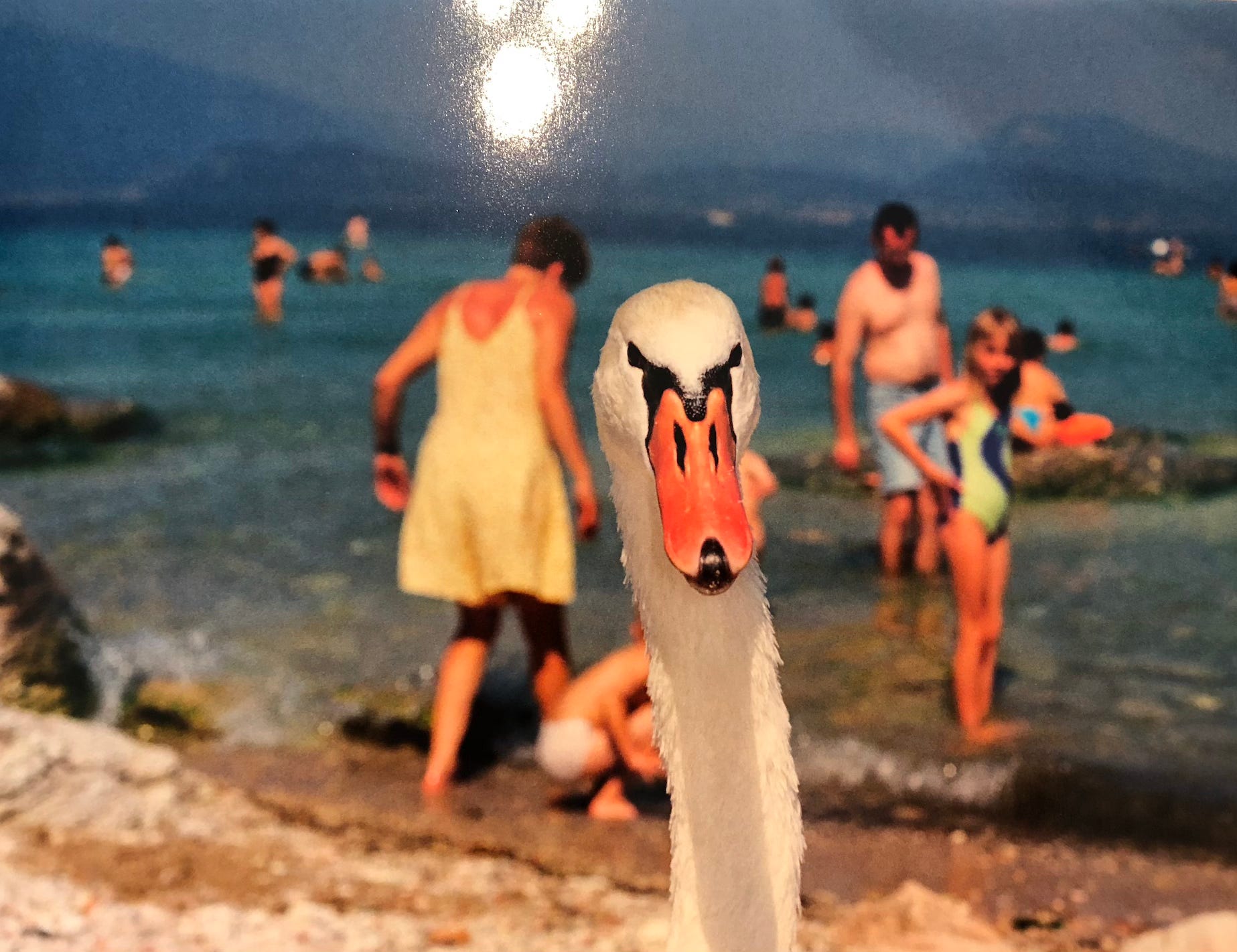
In the case of the witty, Martin Parr photo above, I only briefly noticed the swan (which is the only thing in focus, so how willfully blind am I?) then breezed right past it to linger on the people, beach and sunlight behind it. In fact, I looked at it so briefly that I identified it as “goose” in my mind and then didn’t give it a second thought.
My interest was in the light, contrast, and value range in Parr’s photo. That dark sea behind the saturated oranges and reds of the figures’ skin, the suggestion of features and soft edges: all of it captivated me. I didn’t give a damn about the swan so I stopped seeing it and only studied the sunny world that resonated with my psyche.
Liking it so much, I painted this artist-filtered copy to see what it could teach me about colour and light. I see that I still shied from the fullest red potential of the skin but this has saturated colour beyond what I normally use, and I think it launched me into richer colour and contrast in the next figurative piece that I did: the boy below.
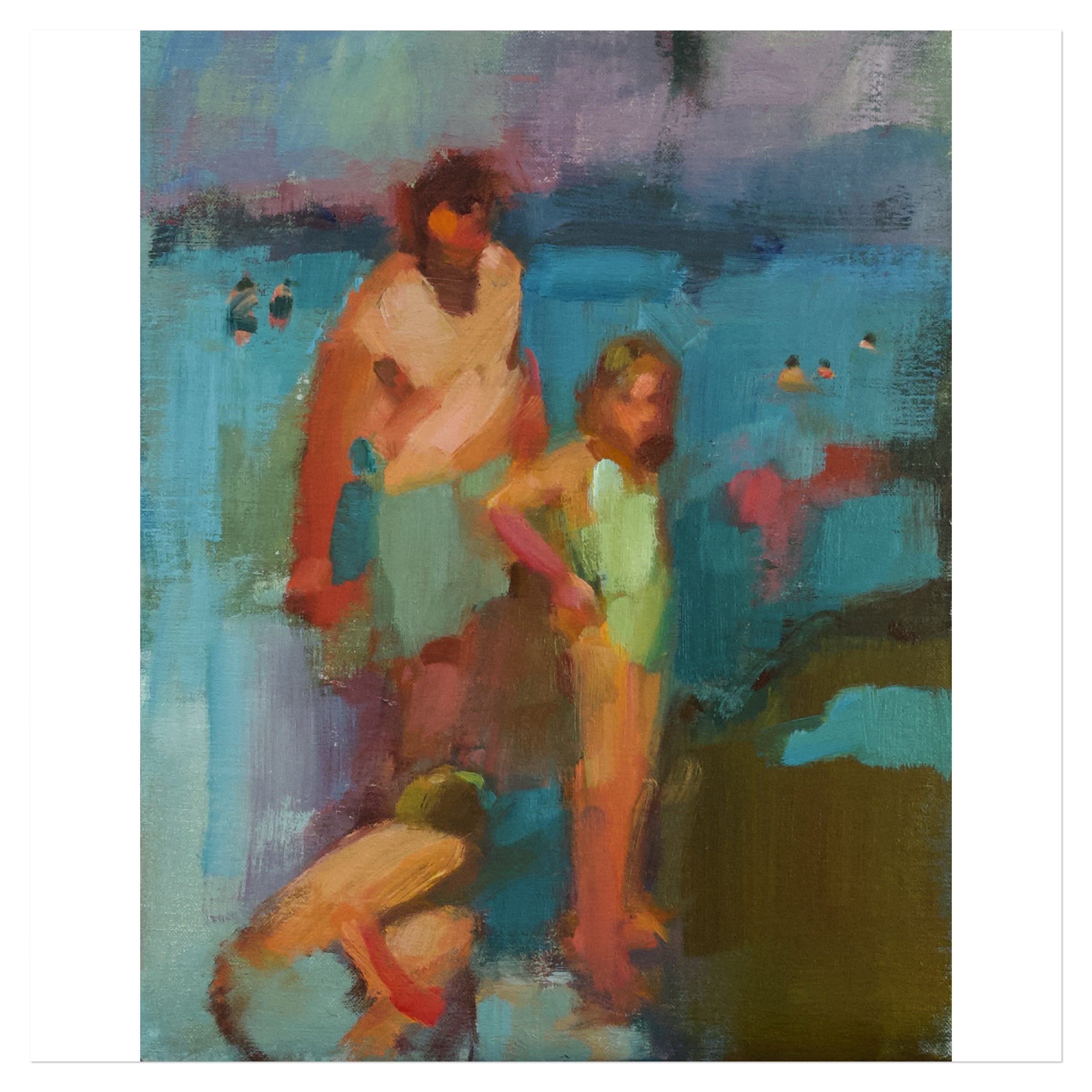
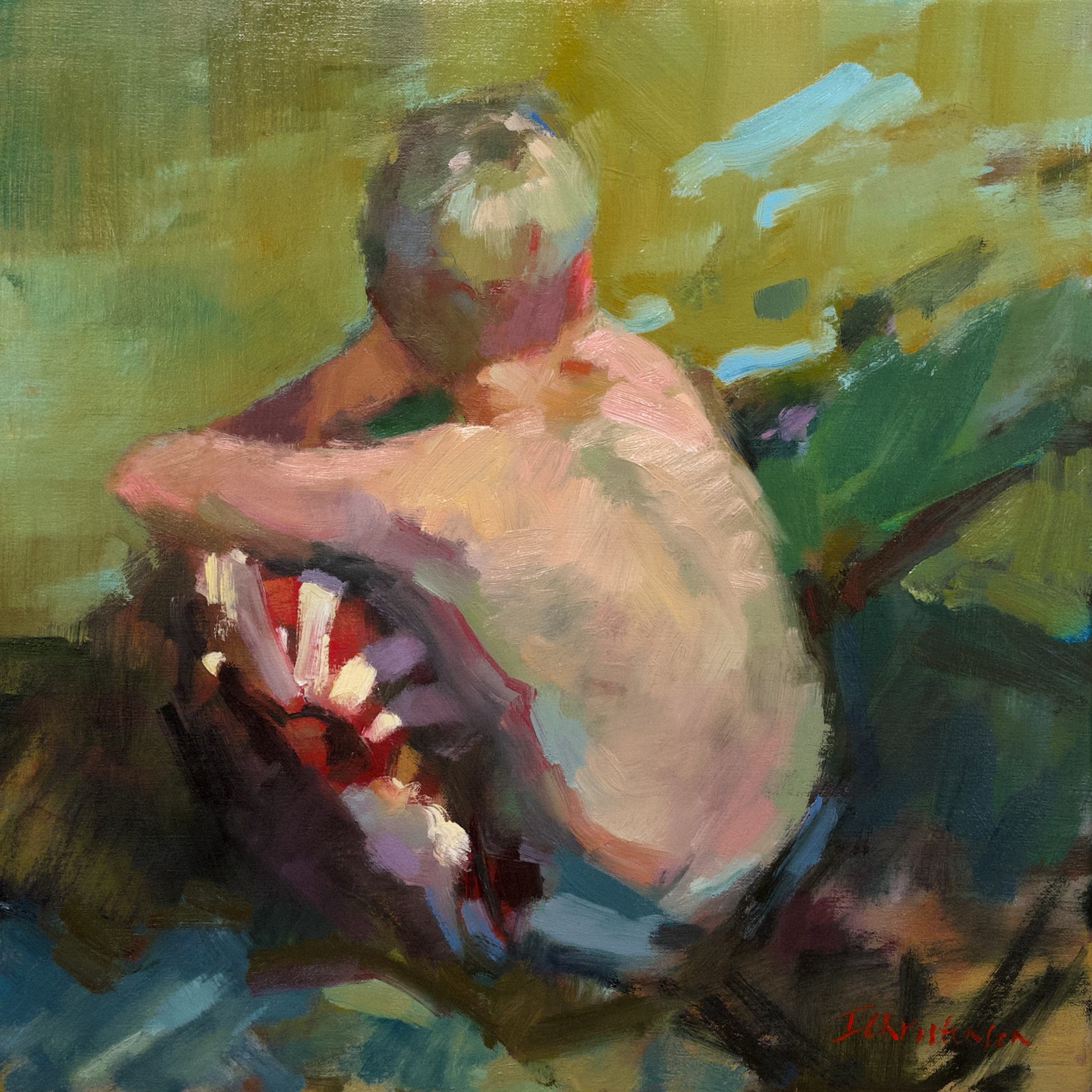
Our visual filters have a huge impact on our artwork. They helps us make work that feels richer and more meaningful than simple copies of reality. My copy would be meaningless if it included the swan, but without it, it’s a launching point for future paintings.
I’m teaching Portraits with the Masters online in September with the goal of understanding how some master artists depicted their subject: what they saw and did not see when they looked at the sitters in front of them.
Because Sargent and Sorolla taught me most of what I know and love about figure painting, that’s where the course will start. We’ll copy the mark making, paint consistency, edge quality and colour palettes in these painters, with the goal of seeing what they emphasized and what they ignored of the visual information in front of them. You’ll also choose your own master artists to copy and learn from.
The most important aspect of the class, though, will be to extend that learning to our own works. How can Sargent’s edges or Sorolla’s colour inform our own portraiture?
Martin Parr helped me to explore saturated colour and deeper contrast than I habitually used and I like the result. Will all of my work have that level of contrast and colour? Definitely not. But it will be something I remember and explore and it will have some impact on my work because everything that I love to look at does. Interesting paintings and engrossing studio days will result from that copy.
If you’d like to join me to see where the masters can lead you in your own work, there are still openings available in Portraits with the Masters.
Happy painting!
PS: this fascinating video shows us selective attention in action.
Your example really gives me “permission” to focus on the unexpected, but as you say, that which interests me the most. Too often I think my brain has been distracted by stuff that does not matter (including details). This is especially so when I’ve gone outside to paint. What really grabs my eye, the whole garden or just that little clump of day-lilies growing out of the compost pile?
Hi Ingrid,
Your words, here, are poetry. From them I could see detailed images of what you described. Sort of like Joni Mitchell's songs, which paint pictures.
Sorry I trailed off in the last class. My little Izzy, Isabelle, Little Bear, was fading fast at the time. I had to put her down - the kidney failure destroyed her life after 20 years. I am struggling, still, with her departure. And once again, I am reminded of our frail mortality - that we face loss at unexpected times, and we wonder why. Yet, it is reassuring that artists buoy us up momentarily by sharing their transcending views of the world. Sort of like magic.
Your version of the picture beautifully captures the shadows and light, and is superior to the photo.